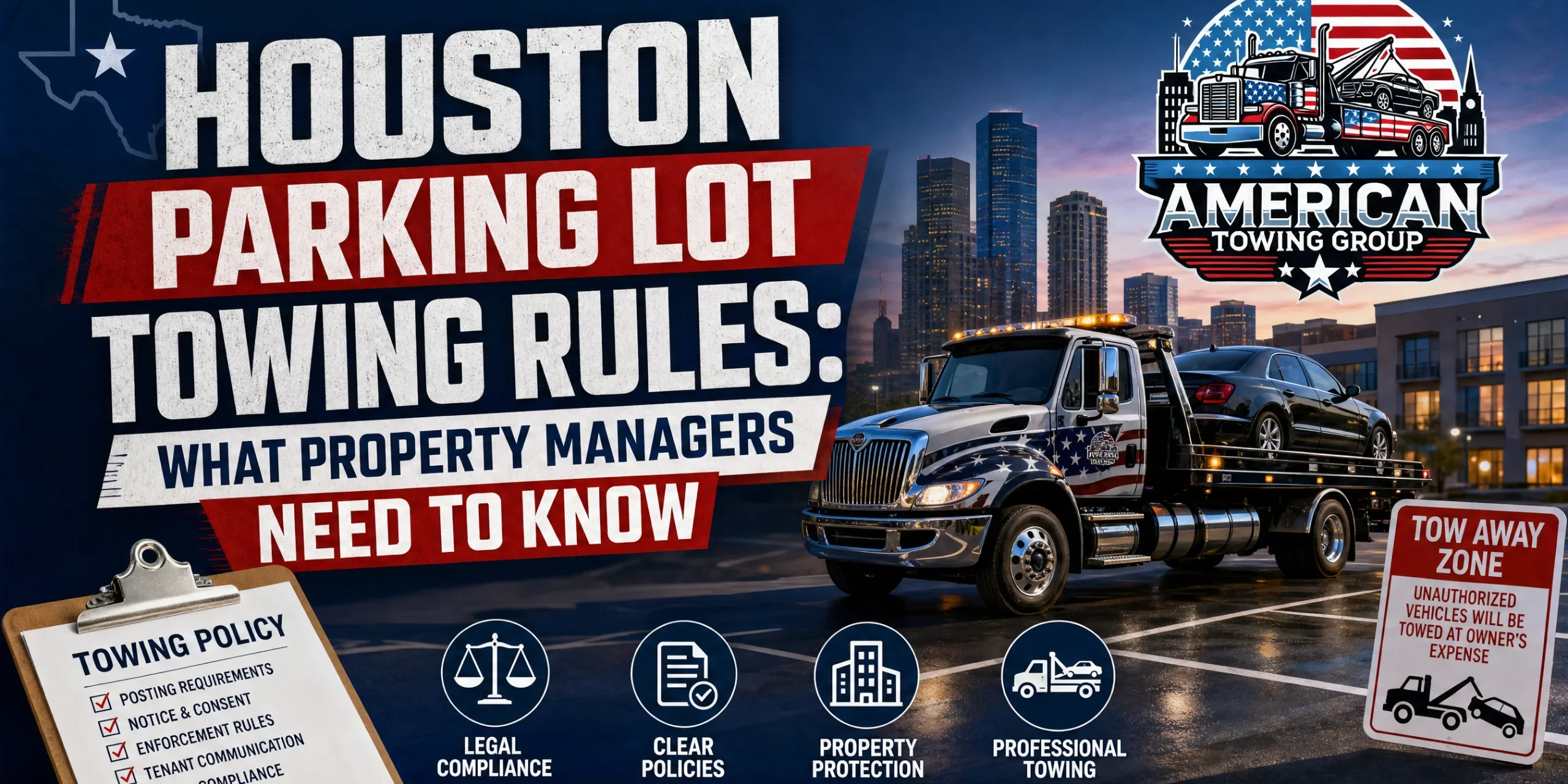
Houston Parking Lot Towing Rules: What Property Managers Need to Know
Houston parking lot towing rules: What property managers need to know
Houston parking lot towing rules set the local requirements for when and how a private property owner or manager can remove unauthorized vehicles from a parking area. They cover the signage, documentation, and notices you need to complete a lawful, low‑dispute tow in Houston, Texas. If you manage apartments, HOAs, or mixed‑use communities in the area, this guide outlines practical steps to stay compliant, reduce friction with residents, and keep your lots orderly. We’ll focus on the essentials that must be in place before any tow happens—signage, permits, documentation, and communication—and how to work with a professional partner to keep enforcement consistent and fair.
Key requirements at a glance
- Visible, compliant signage at property entrances and key areas
- Clear community parking policies and permit rules shared with residents
- Documented violations with time‑stamped photos before any tow
- Authorized decision-maker approval for each tow
- Resident/owner notification and storage information after tow
- Consistent enforcement and recordkeeping to avoid disputes
Quick answer: What do Houston property managers need to tow legally from a private lot?
Start by confirming your tow‑away signs are posted and easy to read. Verify the violation against written parking rules, document the issue with time‑stamped photos, and obtain approval from your designated decision‑maker. Afterward, provide clear post‑tow information and keep thorough records. Partnering with a towing company that offers routine patrols, real‑time notifications, and comprehensive reports helps maintain compliance and transparency at every step.
The basics of Houston towing laws for private property
What counts as “unauthorized” and who can authorize a tow
On private property, “unauthorized” typically means the vehicle violates posted rules: no valid permit, parking in a fire lane, blocking access, overstaying visitor time limits, occupying a reserved or ADA space without proper credentials, or stopping in a signed tow‑away zone. To act, the property owner or the manager’s designated decision‑maker should authorize the tow. Best practice is to keep a clearly documented list of who has that authority (by role and name), when they can give it, and how to reach them. Keeping this list current ensures every tow can be tied to a clear, pre‑approved chain of decision‑making.
Required signage: placement, visibility, and essential details
Effective, lawful enforcement begins with signage. In Houston, managers should ensure tow‑away and parking policy signs are:
- Placed at property entrances and other strategic locations where drivers naturally look
- Readable day and night (consider reflectivity, lighting, and mounting height)
- Durable and maintained (no fading, obstruction, or graffiti)
- Clear on key points: who can park, when enforcement applies, that unauthorized vehicles may be towed, how to contact recovery/storage, and how permits or visitor rules work
Because Houston and Texas requirements can change, work with your towing provider to confirm your signage aligns with current standards. A good partner will help install and maintain signs so they remain compliant and visible. For deeper legal context, see our guide on mastering legal towing and parking laws: Mastering Legal Towing: Enforce Parking Laws & Remove Vehicles Right (https://americantowinggroup.com/unauthorized-towing-mastering-legal-tow/)
Documentation and notice: what to record before and after towing
Before towing, record:
- Time‑stamped photos of the violation (plate, vehicle context, the rule being violated, and nearby signage if relevant)
- The permit or space status (e.g., “no valid permit,” “reserved stall #12,” “visitor limit exceeded”)
- Who authorized the tow and when
After towing, ensure the vehicle owner has direct access to storage information and a clear path to retrieve the vehicle. Keep a complete tow record including date/time, location, vehicle details, violation reason, and photos. This paper trail is often the difference between a brief conversation and a heated dispute.
Parking enforcement regulations that reduce risk and disputes
Clear community policies, permits, and visitor parking rules
Residents can only follow rules they understand. Provide written parking policies at move‑in and during renewals, post them in your community portal, and summarize highlights on entrance or clubhouse bulletin boards. A straightforward permit program—resident decals or hangtags, guest passes, and time‑limited visitor zones—makes enforcement predictable and fair. If you’re evaluating systems, our resource on visitor parking permits and smart tech can help: Mastering Visitor Parking: Smart Tech & Permits for Apartments (https://americantowinggroup.com/visitor-parking-mastering-visitor-par/)
How to handle repeat violators without escalating conflict
Escalate in measured steps:
- Friendly reminder: Share the rule, include a photo if available, and note next steps.
- Written warning: Time‑stamped, with what to correct and a clear deadline.
- Final notice: Explain that future violations will be towed pursuant to posted policies.
- Consistent follow‑through: When the line is crossed, enforce as written.
This “ladder” approach demonstrates fairness and consistency. It’s also wise to document all touchpoints in your records. For more practical steps, see our private property parking enforcement tips: Powerful Enforcement Tips for Private Property Parking Control (https://americantowinggroup.com/private-property-parking-powerful-enfo/)
Working with a professional towing partner for routine patrols
A quality towing provider can perform regular patrols, verify permits, photograph violations, and share real‑time updates with your team before moving a vehicle. This builds trust, keeps everyone aligned, and prevents needless tows. If you’re exploring options, review our reliable parking enforcement overview: Reliable Parking Enforcement: Professional Towing Services (https://americantowinggroup.com/towing-services-for-reliable-parking-enforcement/)
Private property towing in Houston: step‑by‑step compliance checklist
Pre‑tow review: verify signs, permits, and evidence
- Confirm signage is posted, visible, and accurate.
- Check the vehicle against your parking rules (permit database, visitor logs, stall assignments).
- Capture time‑stamped photos showing the violation and context.
- Obtain authorization from your designated decision‑maker.
During tow: safe procedures and minimal disruption
- Prioritize safety: keep communication clear between patrol and tow operator, use cones if needed, and take care around pedestrians and property.
- Respect the community: limit noise, avoid blocking residents, and proceed efficiently.
- Verify details again: confirm plates, VIN (when applicable), location, and reason for tow match your records.
Post‑tow: owner notifications, storage info, and reporting
- Ensure the storage facility and contact details are easy to find for vehicle owners.
- Record the tow comprehensively: photos, timestamps, violation type, authorizer, operator ID.
- Share a concise incident report with your team or HOA board.
- Log the tow in your enforcement history so repeat issues can be managed consistently.
Common mistakes Houston property managers should avoid
Unclear or missing signage
If a sign can’t be read, doesn’t reflect your current rules, or is missing at the entrance, disputes are likely. Inspect signs quarterly and after storms. Replace damaged or faded signs promptly.
Inconsistent permit enforcement
When permits are enforced on some days but not others, residents push boundaries. Align your team, your vendor, and your communications so the rules are applied evenly. Consider routine patrols at predictable times to keep patterns consistent.
Poor documentation and communication
A tow without photos or authorization notes invites conflict. Standardize your photo set (wide shot, plate, violation detail, sign) and follow the same process every time. Provide clear post‑tow information so owners know what to do next. For more best practices, visit Towing Tips and Best Practices (https://americantowinggroup.com/towing-tips/)
Myth vs. fact: Private lot towing in Houston
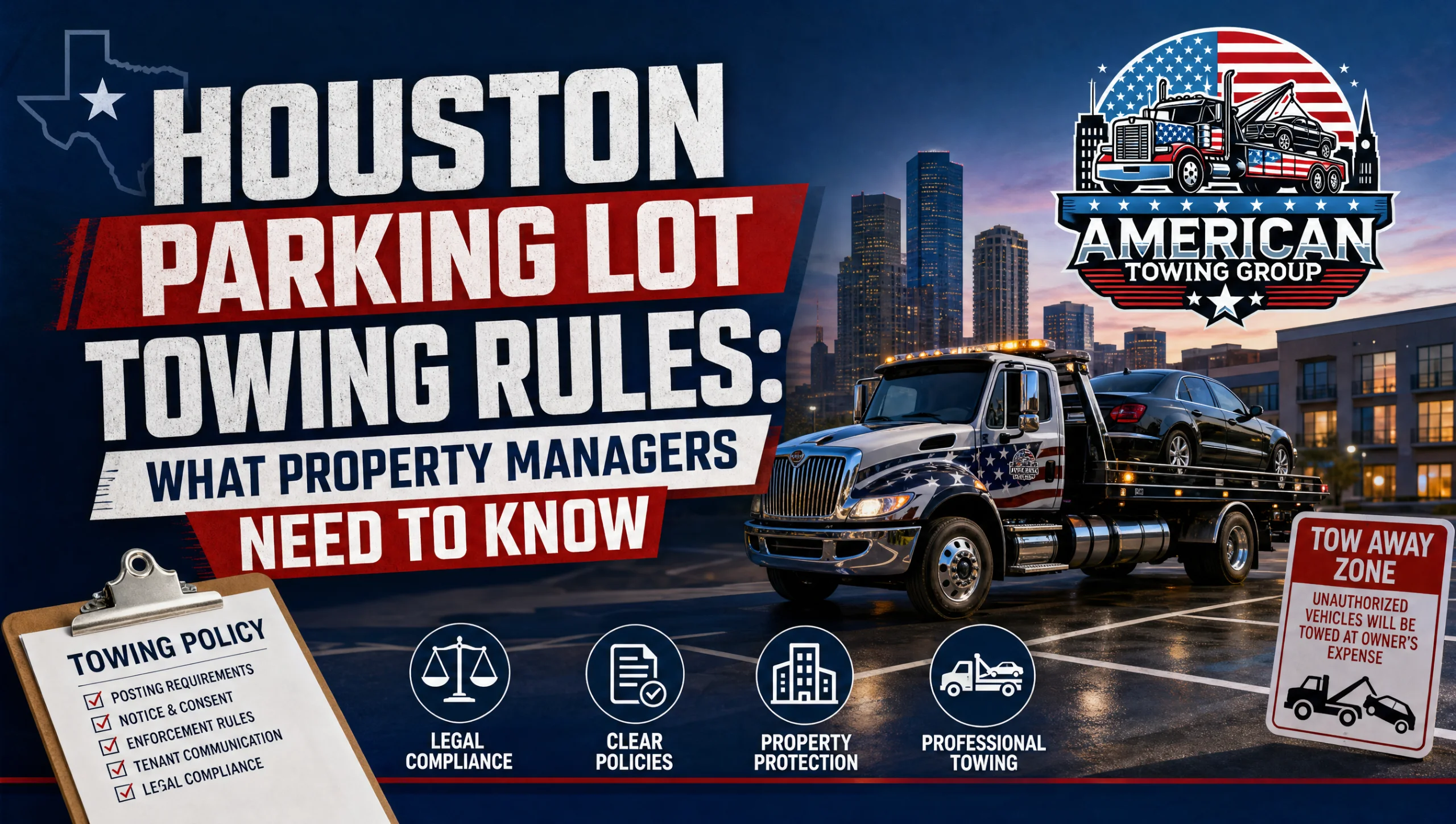
Clear, compliant towing signage helps Houston apartment communities enforce parking fairly and avoid disputes.
- Myth: “If it’s my property, I can tow anytime without signs.”
Fact: Signage and procedural requirements apply. Without visible, compliant signs, you increase legal risk and resident disputes. - Myth: “A verbal warning means we can skip documentation.”
Fact: Document every step. Photos and timestamps protect your residents, your towing partner, and your community. - Myth: “Visitor parking is too hard to manage fairly.”
Fact: Clear time limits, guest permits, and technology make visitor parking manageable and transparent.
How American Towing Services Group supports compliant enforcement
24/7 parking lot towing and rapid response
When enforcement is time‑sensitive—blocked fire lanes, obstructed gates—you need a provider who can respond quickly, professionally, and safely. Our Houston‑based team operates 24/7 to maintain access and order with minimal disruption to residents and businesses. Learn more about our 24/7 parking lot towing services: American Towing Group (https://americantowinggroup.com/)
Parking permit management and signage installation
We help design and manage permit systems that are easy to understand and hard to misuse. From decals and digital lists to visitor workflows, we keep it simple. We also install and maintain signage so it stays readable and aligned with Houston parking lot towing rules and local standards.
Routine patrols with real-time notifications and comprehensive reports
Our patrols document violations with time‑stamped photos and send real‑time notifications to property managers for transparency. After each action, we provide comprehensive reports for your records. This visibility reduces complaints and supports consistent rule application. See how smart towing and AI enforcement trends are improving outcomes: Revolutionizing Parking: Smart Towing & AI Enforcement Trends (https://americantowinggroup.com/smart-towing-revolutionizing-parking-sma/)
Cost‑effective subscription plans with no hidden fees
Parking enforcement should be predictable. Our subscription options are built for apartments, HOAs, and mixed‑use communities—no hidden fees, just clear, professional service and steady results.
First‑hand practice experience
In our day‑to‑day patrols of Houston apartment communities, we’ve found that most towing disputes fade when three basics are in place: a clear photo of the violation, a readable entrance sign that lays out the rules, and a consistent permit system. When managers keep those aligned, our teams can resolve issues quickly and with minimal disruption to residents.
Real‑world scenarios and calm responses
Visitor overflow on weekends
- Risk: Guests spill into reserved spaces and fire lanes.
- Response: Post a weekend reminder via your resident portal, confirm visitor time limits at entrances, and run early evening patrols. Document violations with photos and issue warnings before towing unless access is blocked. If you’re refining visitor procedures, explore visitor parking permits and smart tech: Mastering Visitor Parking (https://americantowinggroup.com/visitor-parking-mastering-visitor-par/)
Repeat violator in a reserved stall
- Risk: The resident next door feels ignored; tensions rise.
- Response: Apply your escalation ladder—document each step, send a dated warning, then tow if the behavior continues. Share a brief post‑incident note with both residents explaining the rule and steps taken.
Blocked access or safety hazards
- Risk: Emergency vehicles can’t reach buildings; liability increases.
- Response: Prioritize safety. Photograph, authorize, and remove the obstruction promptly. For the operational benefits of speed, see the impact of timely vehicle removal: Maximizing Property Value: The Impact of Timely Vehicle Removal (https://americantowinggroup.com/timely-vehicle-removal-maximizing-proper/)
Setting up a compliant program: where to start
- Policy refresh
- Review and update your community parking rules. Make them plain‑language, brief, and specific.
- Align resident, visitor, and vendor parking policies so there are no gray areas.
- Signage and permit audit
- Walk your entrances and internal lots to spot gaps or fading signs.
- Verify permit categories, colors, or digital lists are current and readable.
- Documentation standards
- Adopt a standard photo set and checklist for every tow.
- Define who authorizes tows and how that approval is recorded.
- Vendor alignment
- Choose a partner offering routine patrols, real‑time notifications, and reporting. Confirm they understand Houston’s private property towing landscape.
- Review common scenarios and escalation steps together.
- Resident communication
- Distribute rules at move‑in/renewal and add them to the community portal.
- Send seasonal reminders before high‑traffic times (holidays, move‑in weekends).
For deeper legal background and workflows, our piece on mastering legal towing and parking laws is a useful companion: Mastering Legal Towing & Parking Laws (https://americantowinggroup.com/unauthorized-towing-mastering-legal-tow/) And if you’re dealing with long‑term, unmoved vehicles, see our abandoned car removal guide: Ultimate Guide to Abandoned Car Removal & Towing Laws (https://americantowinggroup.com/abandoned-car-removal-ultimate-guide-to/)
Why consistency matters in Houston communities
Consistency is the backbone of dispute‑free enforcement. When policies, signage, permits, and documentation are aligned—and applied the same way every day—residents know what to expect. That clarity is what prevents arguments at the curb, late‑night calls to the office, or public complaints. It also protects your team: a complete record shows that every action matched posted rules and established procedures.
Image alt text: Houston parking lot towing rules signage at an apartment entrance in Houston, Texas
Your next step: align rules, signage, and a trusted partner
Houston parking lot towing rules become manageable when you keep a compliance‑first mindset: clear signs, written policies, photo‑backed documentation, authorized approvals, and transparent follow‑through. If you want support putting those pieces in place, American Towing Services Group is here to help with 24/7 parking lot towing services, parking permit management, signage installation, and routine patrols with real‑time reporting. Explore our reliable parking enforcement approach here: Reliable Parking Enforcement: Professional Towing Services (https://americantowinggroup.com/towing-services-for-reliable-parking-enforcement/) Or start with our home page to see all services: American Towing Group (https://americantowinggroup.com/)
We’re local to Houston, professional, and respectful of your residents. Let’s make parking predictable, safe, and compliant—without the drama.
Frequently Asked Questions
What signs are required under Houston parking lot towing rules?
Short answer: Post clear, readable tow-away and parking policy signs at entrances and key areas.
Expanded: Houston parking lot towing rules emphasize visible, maintained signage that states who may park, when enforcement applies, that unauthorized vehicles may be towed, and how to contact storage/recovery. Ensure signs are easy to read day and night and kept free of damage or obstructions. Work with your towing partner to confirm your signage remains aligned with current standards. For legal context, see Mastering Legal Towing: Enforce Parking Laws & Remove Vehicles Right: https://americantowinggroup.com/unauthorized-towing-mastering-legal-tow/
Who can authorize a private property tow in Houston?
Short answer: The property owner or a designated decision-maker should authorize each tow.
Expanded: Keep a current, written list of authorized roles/names, how to reach them, and when they can approve a tow. Tie each tow to that decision-maker in your records. This documented chain of approval reduces risk and makes disputes less likely.
What documentation should I have before towing from a private lot?
Short answer: Time-stamped photos, the violation details, space/permit status, and who authorized the tow.
Expanded: Capture wide and close-up photos showing the plate, the context, the rule being violated, and nearby signage if relevant. Record date/time, location, vehicle info, violation reason, and the authorizer. This consistent evidence is often the difference between a quick resolution and a prolonged dispute. For more best practices, visit: https://americantowinggroup.com/towing-tips/
Do I have to notify the vehicle owner before or after a tow?
Short answer: Provide clear post-tow storage and recovery information promptly.
Expanded: After towing, ensure owners can easily find the storage lot and contact details, and document that this information was made available. Keep a complete tow record with timestamps and photos. Clear post-tow communication is essential to minimize conflict and maintain compliance with Houston towing laws.
What counts as “unauthorized” under Houston parking lot towing rules?
Short answer: Parking that violates posted rules—such as no valid permit, blocking access, or using restricted spaces.
Expanded: Typical violations include parking without a required permit, blocking fire lanes or gates, overstaying posted visitor limits, occupying reserved or ADA spaces without proper credentials, or stopping in signed tow-away zones. Verify the violation against your written policies and your permit/space records before authorizing a tow.
How should we handle visitor parking and permits to stay compliant?
Short answer: Use clear time limits and a simple, well-communicated visitor permit system.
Expanded: Share rules at move-in and renewals, post highlights in portals and common areas, and keep enforcement predictable. Consider digital visitor logs or passes to improve transparency. For ideas and workflows, see: https://americantowinggroup.com/visitor-parking-mastering-visitor-par/
How do we deal with repeat violators without escalating conflict?
Short answer: Apply a documented, step-by-step escalation: reminder, written warning, final notice, then tow.
Expanded: Communicate clearly and time-stamp each step. Include photos where possible and specify what must change by when. Consistent follow-through—aligned with posted policies—demonstrates fairness and reduces disputes. Practical tips: https://americantowinggroup.com/private-property-parking-powerful-enfo/
Are routine patrols by a towing provider allowed on private property in Houston?
Short answer: Yes, when aligned with your policies, signage, and authorization process.
Expanded: A professional provider can verify permits, document violations with photos, and send real-time updates before moving a vehicle. This transparency supports consistent, compliant enforcement. Learn more: https://americantowinggroup.com/towing-services-for-reliable-parking-enforcement/
What common mistakes lead to invalid tows or disputes?
Short answer: Unclear or missing signage, inconsistent permit enforcement, and poor documentation.
Expanded: Inspect and maintain signs, apply rules evenly, and standardize your photo-and-approval checklist. Provide clear post-tow information so owners know next steps. More best practices: https://americantowinggroup.com/towing-tips/
How can American Towing Services Group help me comply with Houston parking lot towing rules?
Short answer: We provide 24/7 parking lot towing, permit management, compliant signage, routine patrols, and real-time reporting.
Expanded: Our Houston-based team supports property managers with transparent, professional service: installing and maintaining signage, managing permits, documenting violations with time-stamped photos, and sharing comprehensive reports. Explore our services: https://americantowinggroup.com/ and our reliable parking enforcement overview: https://americantowinggroup.com/towing-services-for-reliable-parking-enforcement/
