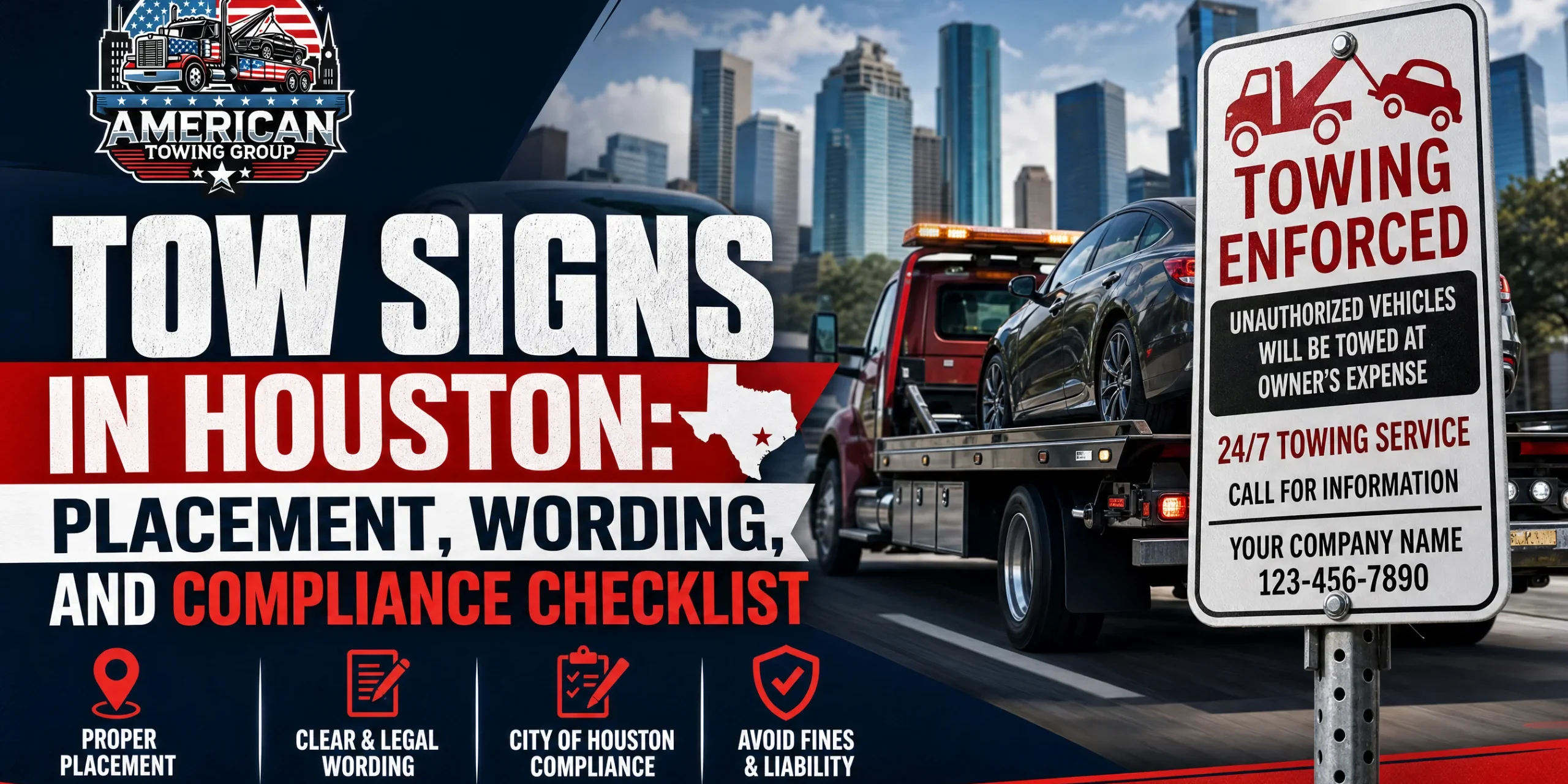
Tow Signs Houston: Placement, Wording & Compliance Checklist | American Towing Services Group
Tow Signs in Houston: Placement, Wording, and a Practical Compliance Checklist
Property managers, HOA boards, and apartment community leaders in Houston know that parking rules only work when they’re easy to see and simple to understand. The right tow-away signs do more than warn; they head off disputes, support lawful towing, and set clear expectations for residents and visitors alike. This guide focuses on tow signs Houston best practices—where to place them, how to word them, and a practical checklist you can use today to keep your community compliant and calm.
Tow Signs Houston: What It Means
When we say tow signs Houston, we’re talking about clearly visible tow‑away and parking enforcement signs on private property in the Houston area that communicate rules, contact details, and consequences so towing can be carried out lawfully and with fewer disputes.
Why Tow Signs Matter for Houston Property Managers
- Lower liability and fewer disputes: Clear, consistent signage is your first line of defense when questions arise about a tow. When rules are visible and readable, residents and visitors are less likely to claim they didn’t know.
- Sets expectations for everyone: Parking enforcement signs create a shared understanding—where permits are required, visitor time limits, loading windows, and what happens if rules aren’t followed.
- Enables timely, lawful action: When signs match current towing signage requirements and your written policies, your team and towing provider can act faster and document each enforcement event with confidence.
What Governs Tow Signs in Houston? (Know the Basics)
City and State Frameworks to Review
- City of Houston Code of Ordinances: Houston’s local rules interact with state towing statutes. Codes change over time, so verify the latest language before updating signage.
- Texas towing and booting statutes (official TDLR): State law outlines how private property tow signs must be posted and what information they should include to support lawful removal. Confirm you’re following current state requirements alongside city guidance.
Note: This guide is practical, not legal advice. When in doubt, check current City of Houston and Texas rules, or consult your property counsel.
Private Property Tow Signs vs. General Parking Signs
- Private property tow signs: These make it clear that unauthorized vehicles may be removed at the owner’s expense, specify who enforces the rule, and provide contact information. They tie directly to legal enforcement.
- General parking signs: These provide rules (e.g., “Resident Permit Parking Only,” “Visitor Parking—2 Hours”). They set expectations but may not, by themselves, meet towing signage requirements unless paired with clear tow-away language.
Tow Signs Houston: Placement Best Practices
Visibility on Entry and Along High-Use Areas
- Prioritize vehicle entrances and gates: Drivers should see tow-away language before they park. Signs at every vehicular entry are the backbone of a defensible program.
- Cover drive aisles and high-demand zones: Add signs along internal drive aisles, visitor areas, fire lanes, loading zones, and near amenities where parking gets tight.
- Reinforce at problem spots: If disputes often arise at a particular building or corner, add a sign squarely in the driver’s line of sight.
Height, Lighting, and Obstruction Considerations
- Maintain readable sightlines day and night: Mount signs at a driver’s eye level and ensure they’re legible under common lighting conditions on your property.
- Avoid obstructions: Keep signs clear of tree canopies, fresh landscaping, construction fencing, and parked vehicles that might block visibility.
- Support nighttime clarity: Where lighting is limited, consider illuminated placements or add fixtures aimed at signs (without creating glare for drivers).
Coverage and Consistency Across Large Properties
- Large complexes and shared lots: Map all entries, internal roads, and any shared parking with neighboring properties. Keep messaging consistent so drivers aren’t confused by shifting rules between sections.
- Multiple buildings: If a building has its own visitor area or reserved stalls, post clear wording that matches the community’s overall policy.
Houston-Ready Durability Tips
- Weather and wear: Houston’s heat, rain, and humidity can fade or warp signs. Choose reflective, UV-resistant materials and rust-resistant hardware, and schedule periodic cleaning to preserve legibility.
- Flood-prone areas: In lower spots that may flood, mount signs high enough to remain visible and intact after severe weather.
Tow Sign Wording: What to Include for Clarity
Plain-Language Rules and Permit References
- Be direct and simple: “Resident Permit Parking Only,” “Unauthorized Vehicles Will Be Towed,” “Visitor Parking: 6 a.m.–10 p.m. (2-Hour Limit).”
- Reference permits clearly: If you use decals, hangtags, or digital permits, say so plainly. State where visitors can obtain permits (e.g., leasing office or a QR code posted nearby).
Contact Information and Towing Provider Details
- Provide who to call: List a phone number for the towing provider and, when appropriate, a community contact line. Clear contacts reduce confusion after hours.
- Identify your enforcement partner: Including your towing company’s name supports transparency and helps drivers resolve questions faster.
Timeframes, Zones, and Exceptions
- Time-limited and location-based rules: If visitor zones shift by time of day, or loading areas allow short-term stops, spell it out concisely.
- Mark special-use areas: Identify fire lanes, loading zones, and ADA spaces unambiguously. Do not remove or replace ADA signage—coordinate placement so ADA signs remain clearly visible and compliant.
Myth vs. Fact: Tow Signs Edition
- Myth: “If I have one tow-away sign somewhere on the property, I’m covered.”
- Fact: Strategic, consistent placement—especially at all vehicle entrances and high-use areas—supports lawful enforcement and reduces disputes.
- Myth: “Legal wording must be complicated.”
- Fact: Plain-language rules that drivers can grasp at a glance are more effective and still align with towing signage requirements when properly verified.
- Myth: “Once installed, signs are set-and-forget.”
- Fact: Landscaping growth, lighting changes, and new construction can make signs hard to see. Regular audits keep your program defensible.
Compliance Checklist: Tow Signs Houston
Use this scannable list to review your current signage. Pair it with a simple lot map and a quick photo log.
Placement verification
- Every vehicular entrance has a clearly visible tow-away sign.
- Additional signs cover internal drive aisles, visitor areas, problem spots, and shared lots.
- No sign is blocked by landscaping, construction, or parked vehicles.
Wording elements
- Plain-language rules (permit requirement, visitor limits, restricted zones).
- Towing consequence stated (e.g., “Unauthorized Vehicles Will Be Towed at Owner’s Expense”).
- Towing provider name and 24/7 contact number.
- Where to obtain permits or information (leasing office, QR code, or portal).
Visibility and accessibility
- Readable in daytime and nighttime conditions; lighting supports visibility.
- Mounted at consistent, driver-friendly viewing height and angle.
- Bilingual consideration where appropriate for your community.
Documentation and photos
- Maintain a lot map marking each sign location.
- Capture clear photos of each installed sign and its surroundings (day and night if possible).
- Store installation dates and any updates or relocations.
Ongoing maintenance and audits
- Quarterly walk-throughs to confirm visibility and consistency.
- Clean or replace faded, damaged, or outdated signs promptly.
- Re-check after landscaping changes, repainting, or construction projects.
- Verify your wording and placement against the latest Houston and Texas rules annually.
Common Mistakes That Lead to Disputes
- Inadequate or blocked signs: A well-written rule won’t help if the sign is hidden by a bush or mounted behind a gate swing.
- Missing contact details: Without a clearly listed phone number and towing provider name, frustrations escalate quickly.
- Mixed or outdated rules: If Building A says “2-Hour Visitor Parking” and Building B says “Visitor Parking Permit Required,” residents will challenge tows.
- No documentation or map: If you can’t quickly show where signs are posted and what they say, you’ll lose precious time addressing complaints.
Documentation, Patrols, and Reporting
Map Your Signs and Keep Photo Logs
- Create a simple diagram of your property with numbered sign locations and attach matching photos to each number.
- Update the map whenever you add, remove, or relocate a sign so leasing staff, security, and your towing provider all follow the same playbook.
Regular Patrols to Confirm Visibility
- Schedule periodic inspections to ensure no new trees, banners, or seasonal décor block visibility.
- Walk the property at night occasionally to confirm lighting is adequate and signs remain readable.
Real-Time Notifications and Reports for Enforcement Events
- When towing occurs, detailed, time-stamped reports and photos protect all parties.
- American Towing Services Group provides transparent communication with real-time notifications and comprehensive reports to streamline this process.
How American Towing Services Group Can Help
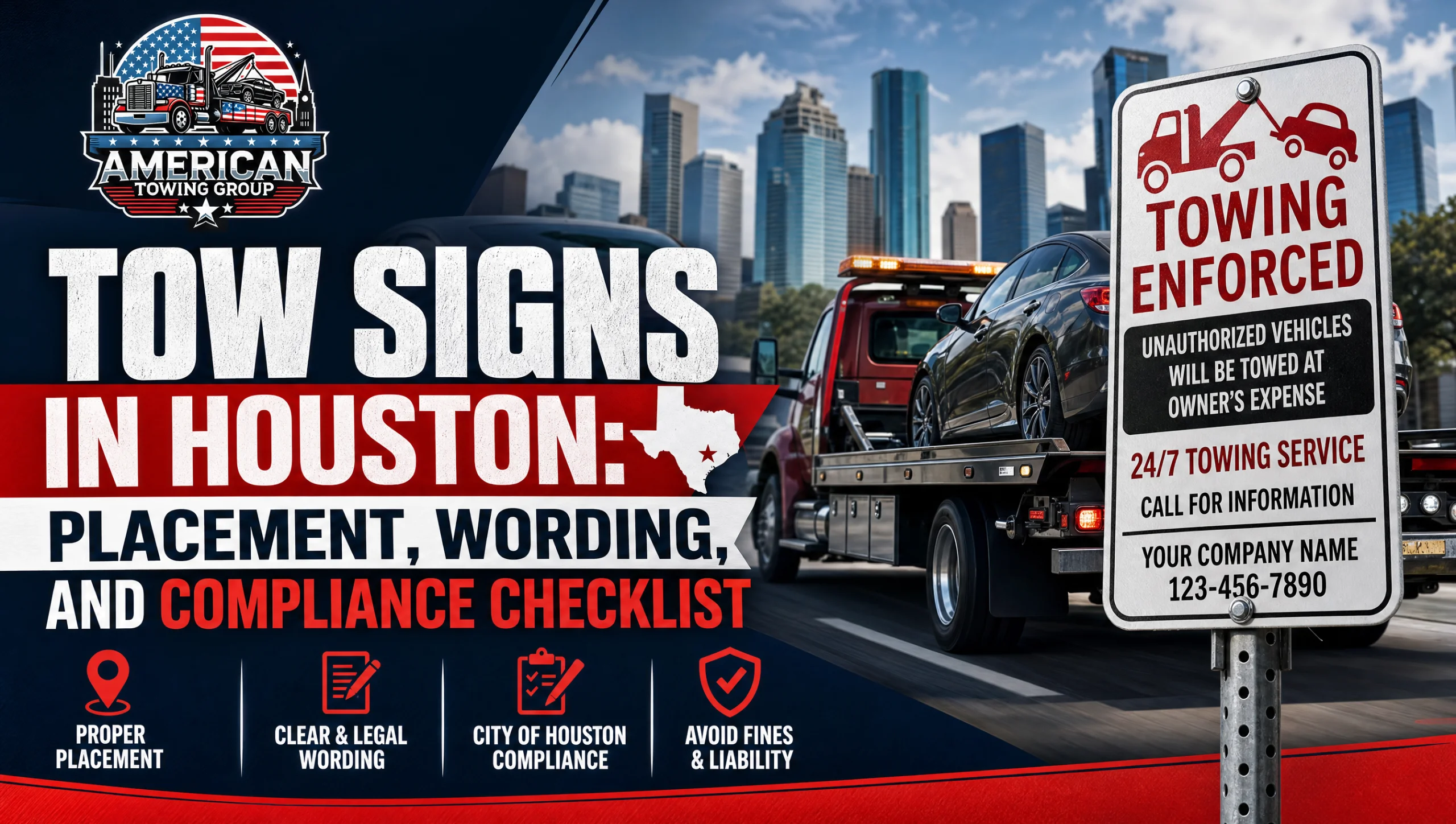
Houston tow signs placed at a lot entrance with clear, compliant wording to support lawful private property towing.
Based in Houston, we support property managers with a complete, compliance-first approach to private property tow signs and enforcement:
- 24/7 parking lot towing to remove unauthorized vehicles with minimal disruption
- Regular patrols and monitoring to address parking violations quickly
- Parking permit management and installation of parking signage
- Customized parking solutions tailored to apartments, HOAs, and residential communities
- Transparent communication with real-time notifications and comprehensive reports
- Cost-effective subscription plans with no hidden fees
If you need fast parking enforcement support or want to tighten your signage program, explore our 24/7 parking lot towing in Houston at https://americantowinggroup.com/. For a broader view of program design, see our reliable parking enforcement services at https://americantowinggroup.com/towing-services-for-reliable-parking-enforcement/. For visitor permit strategy and tech options, visit https://americantowinggroup.com/visitor-parking-mastering-visitor-par/.
Practical, First-Hand Experience
In our day-to-day patrols across Houston apartment communities, we’ve seen how simply relocating a sign from a shaded corner to a well-lit entry point can reduce complaints almost overnight. Pairing clear visitor‑permit wording with a posted lot map in the leasing office keeps expectations aligned and makes any enforcement action more straightforward for staff and residents.
Bilingual Considerations for Houston Properties
- Know your audience: Many Houston communities benefit from bilingual English/Spanish signage to increase clarity for residents and guests.
- Keep both languages concise: Use the same straightforward rules in both languages to avoid confusion.
- Maintain consistency: Ensure bilingual versions appear everywhere you post the English version, especially at entrances and visitor areas.
Simple Method to Map Sign Locations
- Step 1: Print a bird’s-eye view of your property (site plan or satellite image).
- Step 2: Number each vehicle entrance and major internal drive aisle.
- Step 3: Mark each existing tow-away sign and label it with a unique ID.
- Step 4: Photograph each sign and name files to match IDs (e.g., “Sign‑03A‑Day,” “Sign‑03A‑Night”).
- Step 5: Save the map and photos in a shared folder for leasing staff, security, and your towing partner.
- Step 6: Update the map any time you move or replace a sign.
Plain-Language Wording Examples (Illustrative, Not Legal Advice)
- Community-wide rule:
- “Resident Permit Parking Only. Unauthorized Vehicles Will Be Towed at Owner’s Expense. For Assistance: [Towing Company Name & 24/7 Phone].”
- Visitor area:
- “Visitor Parking Only, 6 a.m.–10 p.m. (2‑Hour Limit). No Overnight Parking Without Permit. Unauthorized Vehicles Will Be Towed. Questions? [Phone].”
- Reserved stalls:
- “Reserved Parking—Permit Required at All Times. Unauthorized Vehicles Will Be Towed.”
- Loading zone:
- “Loading Zone—30 Minutes Maximum. No Overnight Parking. Unauthorized Vehicles Will Be Towed.”
These are examples. Verify final wording against current Houston and Texas requirements.
Program Enhancements That Reduce Friction
- QR codes at key signs: Link to your parking rules, where to obtain permits, and who to contact. This is especially useful for after-hours visitors.
- Visitor permit streamlining: Consider digital visitor permits to reduce paper hangtags and improve audit trails. For more on policies that work, visit our visitor parking permits resource at https://americantowinggroup.com/visitor-parking-mastering-visitor-par/.
- Staff alignment: Keep your leasing team, courtesy officers, and towing provider on the same page with a one-page reference sheet: rules, sign map, and contacts.
- Education moments: Include a small parking rules card in move-in packets and post a sign map in the leasing office.
When to Update or Expand Signage
- New complaints from a specific area: Add a clearly visible sign closer to the point of confusion (e.g., end of a drive aisle or next to visitor stalls).
- Policy changes: If you modify visitor hours or permit types, schedule a coordinated sign update so messaging remains consistent everywhere.
- Property changes: After landscaping updates, repainting, or construction, reassess every sign’s visibility and replace faded or damaged panels promptly.
Related Reading for Houston Property Managers
- Learn how to enforce correctly and document each action with legal towing in Houston: https://americantowinggroup.com/unauthorized-towing-mastering-legal-tow/
- Explore private property parking enforcement tips to improve control across your lots: https://americantowinggroup.com/private-property-parking-powerful-enfo/
- Understand how timely vehicle removal can support property value: https://americantowinggroup.com/timely-vehicle-removal-maximizing-proper/
- For general best practices across towing and property operations: https://americantowinggroup.com/towing-tips/
Photo: Example placement of tow-away sign at a Houston apartment entrance (alt: tow signs Houston placement at main entry)
Closing Thoughts: Make Tow Signs Houston Your Compliance Foundation
When tow signs Houston practices are consistent—visible entrances, clear plain-language wording, accurate contact details, and documented sign locations—you create a fair system that supports lawful towing and reduces disputes. If you’re ready to tighten your signage, permits, and patrols, American Towing Services Group can help with installation, visitor/resident permit management, and regular monitoring—backed by real-time notifications and comprehensive reports. Contact us for calm, transparent parking enforcement that respects your community and keeps your lots orderly.
Frequently Asked Questions
What should a tow-away sign include in Houston?
Short answer: Clear rules, tow-away language, who enforces, and a 24/7 contact number.
Expanded: To support lawful towing, private property tow signs should use plain-language rules (permits, time limits, restricted zones), clearly state the consequence (“Unauthorized Vehicles Will Be Towed at Owner’s Expense”), identify the towing provider by name, and list a 24/7 phone number. If you use permits, note how visitors get them (leasing office, QR code, or portal). Always confirm final wording against current City of Houston and Texas towing signage requirements.
Where should tow signs be placed on my property?
Short answer: At every vehicle entrance and along high-use areas.
Expanded: Priority placements include each vehicular entry, high-demand areas (visitor zones, fire lanes, loading zones, near amenities), and recurring dispute spots. Consistency is key across large or shared lots, so drivers aren’t confused by shifting rules. Strategic, visible placement is the backbone of a defensible program in Houston.
Do general parking signs allow towing, or do I need private property tow signs?
Short answer: You need clear tow-away language for enforcement.
Expanded: General parking signs (“Resident Permit Parking Only”) set expectations, but by themselves they may not meet towing signage requirements. Private property tow signs that include explicit tow-away language, enforcement contact, and provider details are necessary to support lawful removal in Houston.
How high and how visible should tow signs be—day and night?
Short answer: Driver eye level, unobstructed, and readable after dark.
Expanded: Mount signs at a consistent, driver-friendly height with clear sightlines. Keep them free of obstructions like landscaping or construction fencing. Where lighting is limited, consider reflective materials, targeted lighting, or illuminated signs to maintain readability at night without causing glare.
Do I need a tow-away sign at every entrance?
Short answer: Yes—every vehicle entrance should have one.
Expanded: Entrance signs establish fair notice before a driver parks. Posting clear tow-away language at each vehicular entry, then reinforcing within drive aisles and hot spots, helps reduce disputes and speeds lawful action when violations occur.
How often should I audit and maintain tow signs?
Short answer: Quarterly checks, plus after any property changes.
Expanded: Conduct quarterly walk-throughs to verify visibility, consistency, and condition. Clean or replace faded or damaged signs promptly. Re-check after landscaping, repainting, or construction. Review wording and placement annually against current Houston and Texas rules to stay compliant.
What documentation helps defend towing decisions?
Short answer: A sign map, dated photos, and enforcement reports.
Expanded: Maintain a property map marking each sign location. Capture clear, dated photos of every sign (day and, if possible, night) and its surroundings. Log installation and update dates. For each enforcement event, retain time-stamped photos and reports. This documentation speeds resolution and helps prevent disputes.
Should Houston communities use bilingual tow signs?
Short answer: Often recommended for clarity, especially English/Spanish.
Expanded: Many Houston properties benefit from bilingual English/Spanish parking enforcement signs to improve comprehension. Keep both languages concise and consistent, and ensure bilingual versions appear at entrances, visitor areas, and other key locations.
Who should drivers call if their car is towed?
Short answer: The towing provider listed on the sign.
Expanded: Each tow-away sign should list the towing company name and a 24/7 phone number, plus a community contact when appropriate. Clear contact details reduce confusion and help resolve questions after hours. If you need a compliance-first partner in Houston, see our 24/7 parking lot towing page: https://americantowinggroup.com/
How can American Towing Services Group help with tow signs Houston?
Short answer: Sign installation, permits, patrols, and 24/7 towing—with transparent reporting.
Expanded: Based in Houston, we install compliant parking enforcement signs, manage resident and visitor permits, run regular patrols, and provide 24/7 parking lot towing with minimal disruption. You’ll get real-time notifications, comprehensive reports, and cost-effective subscription plans with no hidden fees. Learn more about reliable parking enforcement: https://americantowinggroup.com/towing-services-for-reliable-parking-enforcement/ and visitor permit options: https://americantowinggroup.com/visitor-parking-mastering-visitor-par/
If you need fast parking enforcement support or want to tighten your signage program, explore our 24/7 parking lot towing in Houston. For a broader view of program design, see our reliable parking enforcement services. For visitor permit strategy and tech options, visit our visitor parking permits resource.
